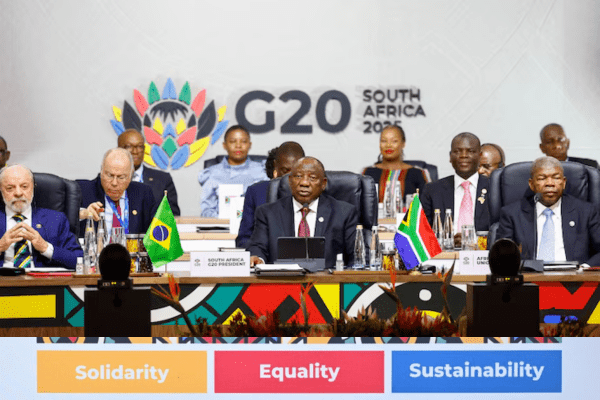
The first G20 summit ever held on African soil closed on 23 November 2025 with a set of technology and data-focused commitments that organisers say respond directly to African priorities around digital inclusion, AI capacity, and policy sovereignty.
Meeting in Johannesburg under South Africa’s presidency, leaders endorsed a USD 100 million B20 Digital Inclusion Fund for African startups, launched an “AI for Africa” voluntary cooperation platform, and backed UNESCO’s new Technology Policy Assistance Facility (TPAF) to help governments build AI and digital-policy capacity.
USD 100m Digital Inclusion Fund for African startups
Announced during the B20 summit — the official business forum of the G20 — the B20 South Africa Digital Inclusion Fund is being built as a blended-capital vehicle combining concessional and commercial finance to reduce perceived risk for investors. Governance structures and anchor commitments are still being finalised, and the fund is not yet open for applications.
Tasked with supporting businesses driving connectivity, fintech for the unbanked, edtech, healthtech and agritech, the initiative stems from the B20 Digital Transformation Task Force chaired by Phuti Mahanyele-Dabengwa of Naspers. Co-lead Shalini Khemka said the fund aims to support solutions for the 2.6 billion people still excluded from the digital economy.
Launch of “AI for Africa” multilateral platform
The G20 Leaders’ Declaration formally welcomed the AI for Africa Initiative, a voluntary cooperation platform intended to expand access to compute, training resources, representative datasets and AI infrastructure across African countries. Leaders linked the initiative to long-term ambitions for sovereign AI capability, more equitable access to global digital value chains, and sustainable models of technology investment on the continent.
UNESCO’s Technology Policy Assistance Facility (TPAF)
To help countries navigate fast-moving AI and technology governance challenges, leaders noted the establishment of UNESCO’s TPAF — an online assistance platform designed to help governments develop evidence-based, internationally informed rules and regulatory frameworks.
Both UNESCO and the G20 highlight this as a response to capacity gaps that risk producing fragmented or inconsistent tech policy across jurisdictions.
A summit shaped by diplomatic tension, but with a unified declaration
Although the summit proceeded without U.S. participation — an unusual departure for a G20 handover year — leaders adopted a joint declaration that places digital infrastructure, data governance and AI capability at the centre of economic inclusion and growth strategies.
South Africa’s presidency framed the summit under the theme “Solidarity, Equality, Sustainability,” and this year’s meeting marked the first G20 summit to follow the African Union’s 2023 admission as a permanent member.
What happens next
Organisers say:
- B20 will finalise governance of the Digital Inclusion Fund, secure anchor LPs, and then issue a call for applications.
- UNESCO will expand TPAF resources to provide policy and regulatory assistance.
- AI for Africa will operate as a voluntary platform where participating countries can share compute, datasets, and AI training capacity.
While timelines and operational details will follow, officials say the initiatives are designed to work together — funding, capability and policy — to reduce barriers to Africa’s digital participation and long-term AI competitiveness.
#G20 #Summit #Johannesburg #Delivers #Digital #Inclusion #Fund #Africa #Platform #Tech #Policy #Facility