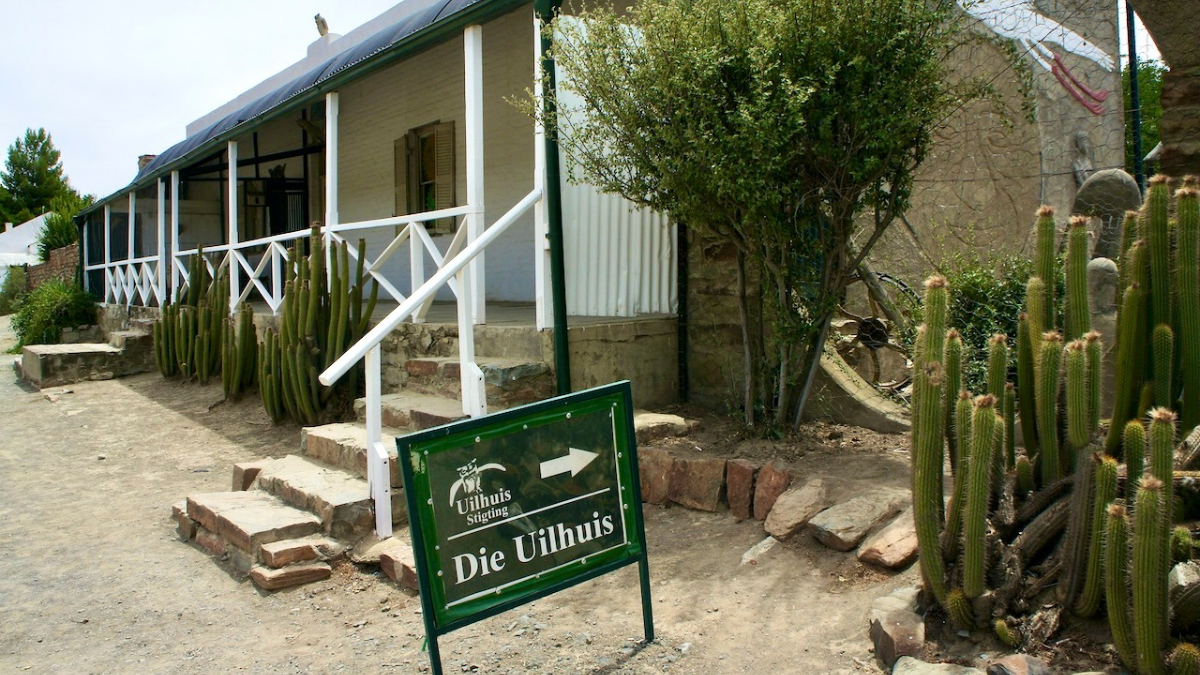
Hidden in the small Karoo town of Nieu-Bethesda is a strange and unique home that once belonged to local teacher Helen Martins.
Today, the Owl House, as it is now known, is a tourist attraction that draws thousands of visitors to the dusty little town.
“The Owl House is one of the primary reasons why visitors stray off the N9 National Road past the Karoo town of Graaff-Reinet,” the Owl House Foundation said.
At first glance, the home may not seem too different from the others, aside from the collection of camel statues and cement owls with glass bottle eyes that stand on the home’s boundary.
The Owl House is a piece of outsider art created by Martins between 1945 and 1976. Driven to despair, Martins transformed her home into a display of light, colours and textures.
Outsider art is defined as art made by self-taught individuals with no contact with the conventions of the art world.
Helen Elizabeth Martins was a shy woman, rarely venturing out of her home. She was born in Nieu Bathesda in 1897, the youngest of six children.
She obtained a teaching diploma in Graaff-Reinet, where she married teacher and dramatist Johannes Pienaar. It was not a happy marriage.
Martins returned to Nieu Bathesda alone in 1928 to care for her frail parents. Her mother passed away in 1941.
This left Martins alone with her father, with whom she had a troubled relationship. She moved him into an outside room, now called the Lion’s Den, with all the walls painted black. He too passed away in 1945.
Once she was left on her own, she began to transform her home, attempting to bring magic, wonder and light into her existence.
Martins hired workers from local sheep farms to break down the house’s small windows and help her fit colourful cathedral glass in its place, filling the space with colourful light.
The tragic story of Helen Martins

She crushed glass in a coffee grinder and applied the glittering shards to walls and ceilings. The rooms became giant kaleidoscopes of colour.
Later in her life, in her seventies, Martins became crippled by arthritis and suffered an increased loss of vision.
According to Artsy, Martins wrote to a friend in 1976 that “Should the doctor advise that I should leave off working, then I shall die; and directly.”
True to her word, Helen took her own life at the age of 78 by drinking a mixture containing caustic soda.
Her legacy, however, continues to bring joy and wonder to those who visit the home she left behind.
Today, the Owl House is one of only two built National Heritage Sites in the Eastern Cape.
All National Heritage sites have been impacted by the Department of Sports, Arts and Culture not being able to fund restorations and maintenance work, as the National Heritage Resource Assistance Fund has been rendered inactive due to budget constraints.
The Owl House is no exception; its ticket sales and shop revenue did not cover the house’s expenses, and the attraction made a loss of R83,530 in the financial year ending in 2024.
This was, however, an improvement compared to the 2022/2023 loss of R374,508. The foundation uses donations to maintain and restore the house, a challenging task when trying to protect the art from the harsh elements of the Karoo..
Despite the subpar financial performance, the tourist attraction consistently brings in thousands of tourists.
In 2023/2024, the house welcomed 10,600 visitors, which the foundation said was roughly the same as the previous year.
In 2026, the Owl House will commemorate the 50th anniversary of Martin’s death in August.
More photos from the Owl House:


#strange #Karoo #home #draws #tourists #year #Newsday