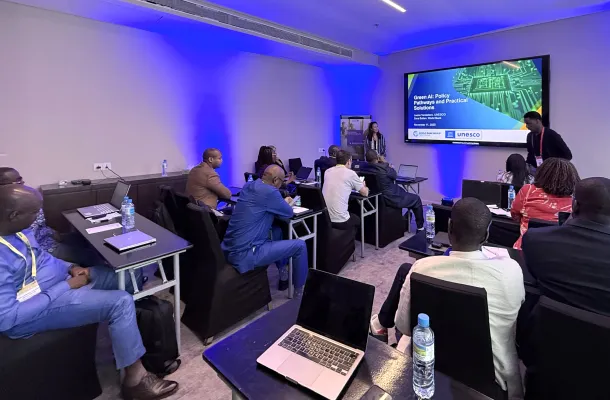
UNESCO and the World Bank convened senior information and communication technology policymakers from across Africa to examine technical and policy approaches for building more resource-efficient and sustainable artificial intelligence systems.
The workshop, held Nov. 11 in Conakry, Guinea, brought together policymakers, regulators and industry leaders alongside experts from UNESCO and the World Bank. It focused on how African countries can integrate environmental considerations into national AI strategies as adoption accelerates.
Discussions centered on “Green AI,” emphasizing that while AI can support development goals, it can also be resource-intensive, requiring significant energy, water and land. Participants reviewed the AI value chain through an environmental lens and explored trade-offs across the full lifecycle of AI systems.
Experts presented two approaches: improving the efficiency of AI systems themselves, described as “Greening AI,” and applying AI to support environmental and sustainability goals, described as “Greening with AI.”
UNESCO shared findings from its report, Smarter, Smaller, Stronger: Resource-Efficient Generative AI and the Future of Digital Transformation, which outlines technical methods for reducing AI’s resource demands. The report notes that model compression techniques such as quantization can cut energy consumption by up to 44%, while shorter prompts and outputs can reduce energy use by more than 50%. It also found that task-specific small language models can deliver up to 90% energy savings compared with large language models while maintaining high accuracy.
Policy levers were also highlighted as critical. UNESCO and the World Bank noted that national digital and AI policies influence the development of data centers and telecommunications infrastructure, while sector-specific policies covering water, energy, mineral resources and environmental management can also shape the sustainability of AI ecosystems.
The World Bank presented case studies from Nigeria, Singapore and Chile to illustrate how different policy frameworks can support green AI across varied contexts.
The workshop was facilitated by Leona Verdadero, a program specialist in digital policies and digital transformation at UNESCO, and Hawa Siga Diankon, a digital development project associate for West and Central Africa at the World Bank.
The session was held as part of the seventh Transform Africa Summit and contributed to broader regional efforts to develop an AI-ready digital future. UNESCO said it will continue supporting African countries in building inclusive and sustainable AI ecosystems and strengthening capacity for green digital transformation.
#UNESCO #World #Bank #Urge #African #Policymakers #Prioritize #Sustainable