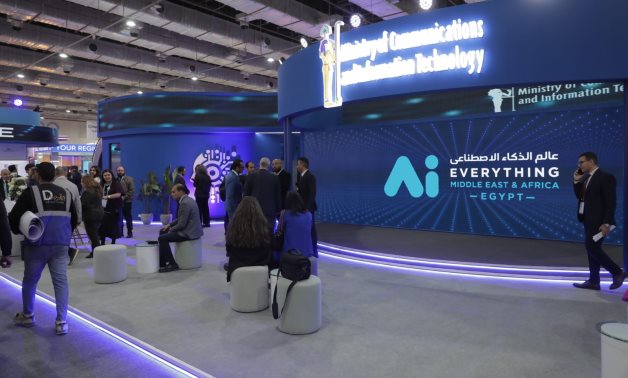
Egypt concluded its first regional edition of the AI Everything Middle East & Africa Summit last week, marking a significant step in the country’s effort to establish itself as a hub for artificial intelligence, innovation and digital investment in the region.
Held Feb. 11-12 at the Egypt International Exhibition Center under the patronage of President Abdel Fattah El-Sisi, the summit drew decision-makers, global technology leaders, more than 100 investors and entrepreneurs from more than 30 countries. Organized by the GITEX Global network in strategic partnership with the Information Technology Industry Development Agency, the event featured more than 350 AI-focused companies and startups, making it one of the largest technology gatherings in the Middle East and Africa.
Minister of Communications and Information Technology Raafat Hindy, represented at the opening session by Information Technology Industry Development Agency CEO Ahmed El Zaher, said Egypt views AI not merely as a technological advancement but as a national capability designed to generate societal impact and accelerate development across priority sectors. He outlined a six-pillar national AI framework focused on intelligence, societal relevance, governance, accessibility, capabilities and skills development.
Among the summit’s headline announcements was the launch of Karnak, a national large language model integrated into Egypt’s public digital infrastructure. Ranked among the top-performing Arabic-language models in its parameter class, Karnak is expected to serve as a foundation for startups and private companies developing AI applications tailored to local and regional needs.
Two AI-powered national applications were also unveiled: Sia, a personal AI tutor supporting secondary school students and teachers in Arabic language and Egyptian history, and an intelligent legal and regulatory assistant designed to help citizens and small and medium-sized enterprises navigate regulatory frameworks.
In the healthcare sector, Egypt introduced locally developed AI tools for early detection of diabetic retinopathy, macular edema and breast cancer. Built by Egyptian engineers and trained on local data, the tools aim to expand early diagnostic capabilities and improve healthcare access. Egypt is also working with the U.N. Development Programme to share these solutions with Arab and African countries through the AI-Share initiative.
Additional tools launched at the summit included Tarjuman, a machine translation application, and Bel Masry, a system capable of understanding Egyptian colloquial Arabic and performing speech-to-text, translation and text-to-speech functions. A new language-learning app, Lughat, was also introduced to strengthen English proficiency and workforce competitiveness, particularly in the outsourcing sector.
Officials noted that since the launch of Egypt’s National AI Strategy in 2019, the country has advanced 60 positions in the global AI Readiness Index. The second phase of the strategy, covering 2025-2030, aims to embed AI across key sectors including healthcare, agriculture, education, justice and public services within a responsible governance framework.
The event also featured the AI MEA Supernova startup competition, advanced training programs through the AI Academy in collaboration with AWS, and an AI hackathon sponsored by Capgemini. Senior government officials, ambassadors and technology leaders attended the opening ceremony, including Mauritania’s Minister of Digital Transformation and Administrative Modernization Ahmed Salem Ould Bede.
#Egypt #Hosts #Regional #Summit #Unveils #National #Language #Model #Suite #Homegrown #Tools