A Nelson Mandela University researcher has called for a fundamental rethinking of how artificial intelligence and digital humanities frameworks are applied in African contexts, following his participation in an international workshop in Hannover, Germany.
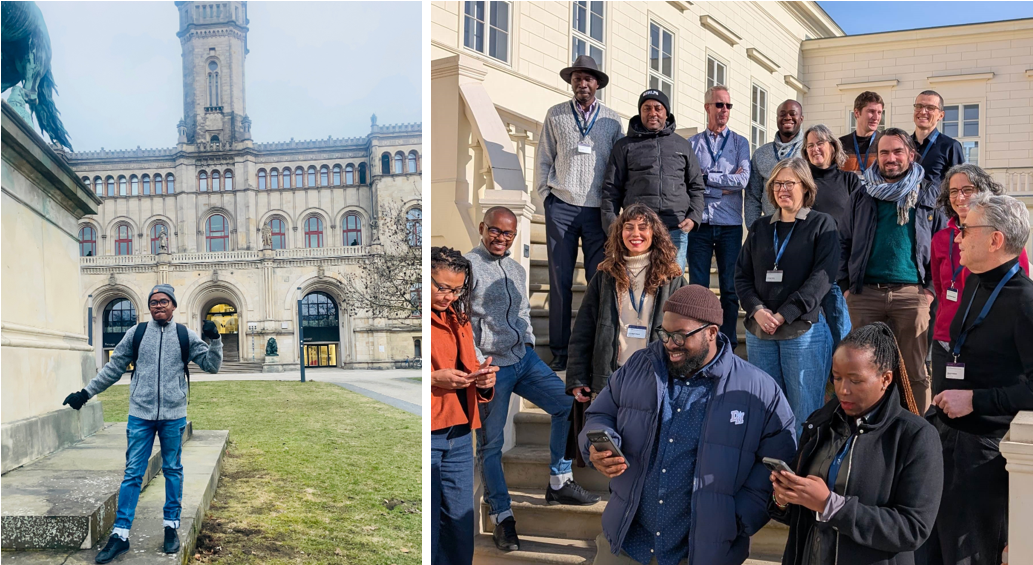
Dr. Johannes Sibeko, a senior lecturer in the Department of Linguistics and Applied Linguistics and newly elected vice president of the Digital Humanities Association of Southern Africa, was among 27 thought leaders from 16 countries invited to the three-day scoping workshop at the Xplanatorium Herrenhausen. Titled “Charting New Territory: Digital Humanities and AI in African Studies,” the gathering brought together experts from Africa, Europe and beyond to assess the convergence of digital humanities and AI in context-aware ways.
Sibeko said one of the clearest findings was the limited transferability of frameworks developed in the Global North when applied without critical adaptation to African contexts. He noted that while such frameworks are often expansive, they tend to overlook African linguistic diversity, sociocultural realities and historical power imbalances in knowledge production.
Data sovereignty also emerged as a central concern. “Communities whose languages and cultural resources underpin digital humanities and AI research often retain limited control over how their data is collected, governed, reused and monetised,” Sibeko said.
He described the workshop as a departure from conventional approaches to the field. “For a change, we discussed African digital humanities and AI from an African studies perspective, not as a variant of general global digital humanities and AI,” he said. “This convergence is essential for developing AI tools that are not only technologically effective but also intellectually grounded, socially responsible and aligned with African scholarly and community practices.”
Sibeko said he sought to bring a corpus linguistics perspective into dialogue with digital humanities practice and institutional realities, including contributions on governance models, the long-term stewardship of language data and institutional responsibilities around data ownership and consent.
A key outcome of the workshop is a co-authored position paper outlining strategic recommendations to guide future research, policy and funding. Sibeko said the paper will serve as a conceptual and ethical framework for the university’s Digital Humanities Hub, informing future projects, grant applications and postgraduate supervision. It will also be used as a teaching and reference text in digital humanities modules.
Building on the workshop, Sibeko said he hopes to advance the theorization of digital humanities from a Southern African perspective, particularly around questions of visibility in African studies and what it means to meaningfully incorporate Africanization into both curricula and research practice. “I hope this line of thinking will help us develop more grounded and relevant approaches to digital humanities and AI — approaches responsive to Southern African contexts rather than simply adapted from elsewhere,” he said.
#Mandela #University #Scholar #Joins #Global #Workshop #Pushing #AfricaCentered #Approach #Digital #Humanities