From mineral exploration to the world of financial services, artificial intelligence is changing the way businesses operate in Africa. One area that may be most impacted by this technological revolution is a place that receives relatively little attention in this context: the creative economy.
For generations, storytelling has been one of the strongest tools for the people of Africa. Film, music, and other forms of media have captured those elements of storytelling to create digestible content. Now, a combination of mobile technology and artificial intelligence is changing everything and offering a new generation of creative individuals a seat at this table. For most of the world, filmmaking has been a process that requires expensive equipment, training and access to a studio. Today, where mobile penetration has grown exponentially in the continent, this is no longer the case. For African creatives, the smartphone is more than just a camera; it’s a filmmaking tool unlike any other in recent history.
Artificial intelligence is changing everything in filmmaking from editing and visual effects to subtitling and translation and even developing ideas and concepts themselves. This is a significant development for a new generation of filmmakers in Africa and around the world.
For filmmakers in Africa and around the globe, this means that ideas are being produced and presented faster and more cost effectively than ever before.
Creativity as Economic Infrastructure
The global creative economy is estimated to be worth more than $2 trillion, and it continues to expand rapidly. Africa’s role in this economy is also expanding exponentially due to a combination of a young and growing population and a global appetite for diverse stories and ideas. Short form films in particular have played a critical role in this growth. AI could potentially drive this growth even further, especially if it assesses the technical requirements of production, allowing storytellers to focus more on story-telling. However, while technology continues to grow, one could argue that the true essence of art could potentially lie not in the tools, but in the perspectives.
Digital platforms, from streaming services to social media, have created distribution pathways that bypass traditional gatekeepers. Artificial intelligence may accelerate this transformation even further by simplifying the technical aspects of production and allowing creators to focus on storytelling itself. But as technology advances, the real value of creative work may lie not in tools, but in perspective.
AI can certainly generate visuals and automate editing workflows, but it lacks to replicate the lived experiences that shape authentic storytelling. Africa’s diverse languages, landscapes, cultures, and histories remains a powerful source of narrative depth that technology alone cannot reproduce.
Responsible Innovation in the Age of AI
With AI tools set to become even more accessible, discussions around responsible innovation are becoming increasingly important. Training large AI models and running advanced computing systems require significant energy resources, raising important environmental questions.
Ongoing global climate change has continued to trigger adverse events, disproportionately impacting millions of people in the Global South. The energy constraints of AI and the growing adoption of this technology poses a great deal of concern. Creative industries can play an important role in shaping that conversation. Films and digital media remain powerful vehicles for raising awareness around environmental challenges, from climate change to conservation.
When creators use AI responsibly, these technologies can support storytelling that not only entertains but also informs and inspires action.
A New Generation of Storytellers
Across the continent, creative platforms are beginning to explore how emerging technologies can support new forms of storytelling.
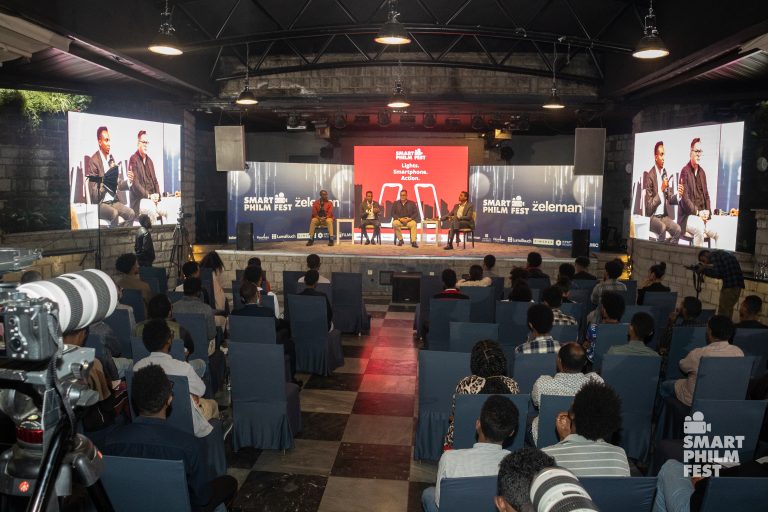
One example is CRAFT, a creative festival taking place in Addis Ababa this May, organised by Ethiopian creative agency Zeleman. The event brings together innovators across design, media, and technology to explore the future of creativity in Africa.
As part of the event, SmartPhilm will showcase films shot entirely on smartphones, demonstrating how accessible technology can empower creators to produce compelling stories with minimal equipment.
This year’s festival also invites filmmakers to reflect on themes around AI, humanity, and environmental responsibility, highlighting the growing intersection between technology and storytelling.
The Future Is Being Filmed Now
Africa’s AI momentum is often measured through infrastructure investments, policy development, and startup growth. But the continent’s creative sector represents another equally powerful frontier.
Technology can provide the tools. Policy can shape the frameworks. Investment can accelerate innovation. But stories remain the bridge between technology and society.
As artificial intelligence continues to evolve, Africa has an opportunity not only to adopt these tools but to shape how they are used—to amplify human creativity, preserve cultural narratives, and address global challenges.
The next wave of filmmakers may not come from traditional studios.
They may come from a smartphone.
And increasingly, they may come from Africa.
#Smartphones #Africas #Creative #Revolution #Motion