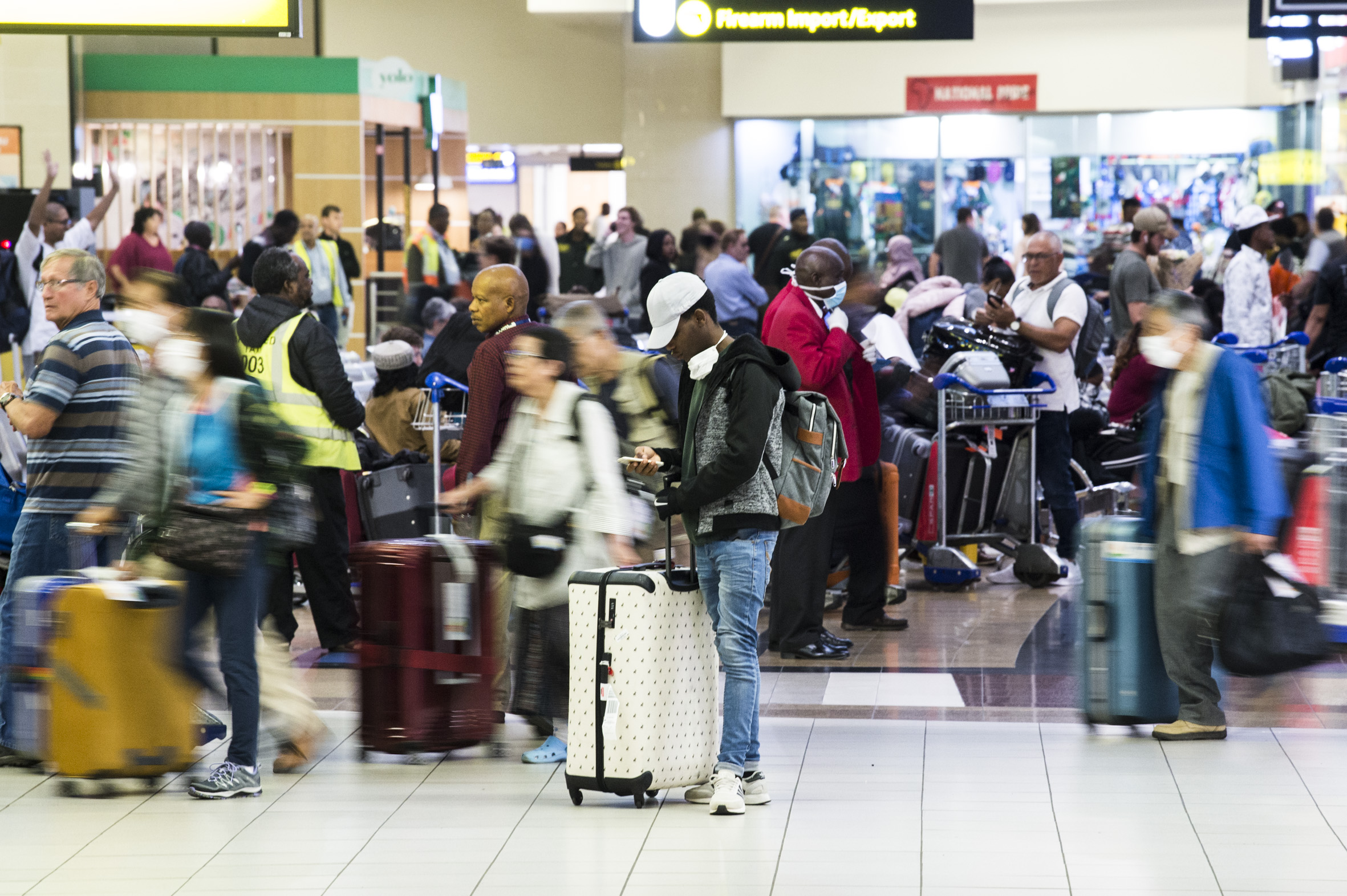

Travel: Visitor numbers are rising again and airports like OR Tambo are getting busier. Photo: Delwyn Verasamy
I found myself reflecting deeply during our recent strategy session at the Tourism Business Council of South Africa (TBCSA). What began as a routine discussion about global developments turned into something far more profound when one of my colleagues referenced an emerging ranking placing South Africa among the top 10 countries considered safe enough for extended stays amid rising global tensions.
The context was sobering. The world is once again watching conflict unfold, this time through the escalating hostilities involving the United States, Israel and Iran. Such geopolitical instability reshapes global travel patterns almost overnight. In moments like these, travellers do what human beings have always done: they seek safety, stability and places where life feels possible again.
Against this uncertain global backdrop, South Africa appearing on a list of destinations perceived as relatively safe is no small matter. It is a reminder that even in turbulent times, our country remains a place the world looks to with curiosity and hope.
But the reflection did not lead to celebration alone. It raised a deeper question for all of us around the table: Are we ready to seize this moment?
Although global instability may temporarily redirect travel flows, the real opportunity lies not in benefiting from conflict elsewhere but in ensuring that South Africa becomes a destination the world actively chooses, whether there is conflict in other regions or not.
We must remind ourselves that opportunity may knock unexpectedly but preparation determines whether the door opens.
Recent tourism figures suggest that the sector is on a path to recovery. Visitor numbers are rising again. Airports are busier. Hotel occupancy rates are improving. Tour operators are cautiously optimistic.
These numbers matter. But they do not tell the full story.
Around the boardroom table, many of us represent businesses operating at different points of the tourism value chain: hotels, tour operators, transport companies, attractions and service providers. Although the numbers may show growth, the lived experience across the sector tells a more complicated story.
For many businesses, especially smaller operators and those outside major metropolitan areas, the recovery remains uneven and incomplete.
As I often remind colleagues and policymakers alike: “Numbers can comfort us but they can also conceal the work that still lies ahead.”
Growth in arrivals does not automatically translate into growth in livelihoods.
Behind every statistic is a guide waiting for the next tour group; a family-owned guesthouse trying to rebuild after years of disruption; a township entrepreneur hoping international visitors will once again walk through their neighbourhood with curiosity rather than caution.
For them, recovery is not theoretical. It is personal. This is why complacency would be our greatest mistake.
The global environment is shifting rapidly. Geopolitical tensions, economic uncertainty and changing trade relationships are reshaping the movement of people across borders. At the same time, technology is transforming how destinations are discovered, evaluated and ultimately chosen.
In such times, tourism does not reward those who wait. It rewards those who prepare.
In moments of global uncertainty, the destinations that succeed are those that prepare while others hesitate.
South Africa has many advantages. Few countries can offer our combination of natural beauty, cultural diversity, world-class hospitality and powerful historical narratives.
But advantages alone do not guarantee success. They must be supported by deliberate strategy and consistent execution.
One encouraging development has been the progress made through Operation Vulindlela, particularly regarding reforms that directly affect the tourism sector. Improvements in visa processes and regulatory frameworks may appear technical on the surface but their effect on accessibility and competitiveness is significant.
A traveller choosing between destinations rarely sees the internal policy work behind the scenes. They simply experience whether entry into a country feels easy or frustrating.
Visa reform, improved digital systems and smarter border management all play a role in ensuring that South Africa remains accessible to the world.
But policy reform alone cannot carry the sector.
The responsibility to build a thriving tourism economy ultimately belongs to all of us: government, business, communities and civil society.
This brings us back to the question I believe we must ask ourselves constantly: Are we shifting the needle? It is a simple question, but a powerful one.
Are our efforts leading to measurable improvements in visitor numbers, investment and job creation?
Are we expanding tourism beyond traditional destinations so that more communities share in its benefits?
Are we strengthening the sector’s resilience so that the next global disruption does not undo years of progress?
Our work must deliver a visible effect for three key constituencies.
The first is the traveller — the person deciding where to spend their time, curiosity and resources. For them, South Africa must be easy to reach, easy to explore and impossible to forget.
This means improving air access from key markets, expanding route connectivity and ensuring that our airports, roads and infrastructure meet global expectations.
It also means strengthening the meetings, incentives, conferences and exhibitions (MICE) sector, which has the potential to bring high-value visitors into our cities while showcasing South Africa’s capacity for global leadership.
The second constituency is the tourism business community: the entrepreneurs, operators and employees who power the industry every day. Their ability to grow depends on predictable regulation, supportive policy environments and access to markets.
And the third constituency is the country itself.
Tourism is not merely a leisure activity. It is an economic engine capable of generating employment, stimulating investment and showcasing the best of South Africa to the world.
President Cyril Ramaphosa has repeatedly described tourism as a sector capable of driving growth and job creation. Yet the practical prioritisation of the sector across government and the broader economy has not always been consistent.
Advocacy must therefore evolve. It must move beyond simply speaking about tourism’s potential to demonstrating its effect.
When tourism grows, rural communities gain new opportunities. Small businesses gain customers. Young people gain pathways into the economy.
But perhaps the most important element of tourism is perception.
Destinations are not chosen solely based on geography or attractions. They are chosen based on how the world feels about them. We must remind ourselves that, in tourism, perception is not a soft issue; it is the front door to the economy.
The digital age has amplified this reality. Online platforms, global media narratives and emerging technologies such as artificial intelligence increasingly shape how countries are perceived long before travellers set foot on their soil.
This means South Africa must become far more deliberate in how it tells its story. We must embrace technology not only to improve operational efficiency but also to shape global perceptions of who we are as a nation.
A compelling national narrative, grounded in authenticity, resilience and possibility, can be one of the most powerful tourism assets any country possesses.
Yet as important as strategy and technology may be, there is something even more fundamental required for tourism to thrive: unity.
Tourism succeeds when a country presents itself to the world as a cohesive team rather than a collection of competing interests.
And so, in moments like this, we must remind ourselves that we are ultimately working towards a shared objective: Team South Africa.
Our task is to raise the profile of South Africa as a destination that the world actively chooses to visit, not merely one that appears on travellers’ itineraries by chance.
If we succeed in this mission, tourism will not simply recover. It will become one of the pillars of South Africa’s economic future.
For us to succeed, I believe three reflections must guide our approach.
The first is unity of purpose. Government, business and communities must align around a shared vision for tourism growth.
The second is urgency and agility. The global travel landscape is evolving quickly. Decisions that once took years now shape outcomes in months.
And the third is the effect that shifts the needle. Tourism strategies must translate into real improvements on the ground: more visitors, more jobs and more opportunities for South Africans.
Or, as I prefer to put it: “When purpose is clear, urgency becomes natural and effect becomes inevitable.”
As we look ahead, it is worth remembering that travel has always been more than movement across geography. It has often been a journey towards transformation.
Few understood this better than Nelson Mandela. Long before the world knew him as Madiba, he travelled across Africa and beyond in the early 1960s seeking support for the struggle against apartheid. Those journeys helped build the international solidarity that would eventually change South Africa’s destiny.
Madiba understood something profound: that travel can be a bridge between people, ideas and possibilities.
Today, tourism offers South Africa another opportunity to build such bridges, this time towards shared prosperity. But achieving this will require action from every sector of society.
The government must continue to remove barriers and prioritise tourism as a strategic economic driver. Businesses must invest in innovation, quality and global competitiveness. Communities must embrace tourism as a pathway to opportunity.
And as citizens, we must all recognise that the way we welcome the world shapes the way the world sees us. If we pull together with purpose and conviction, South Africa will not merely benefit from moments of global uncertainty.
We will become a destination defined by possibility. And in doing so, we will honour Madiba’s legacy, proving once again that travel, when guided by purpose, can change the course of a nation.
Jerry Mabena is a chairperson of the Tourism Business Council of South Africa (TBCSA).
#Tourism #SAs #defining #story #Mail #Guardian