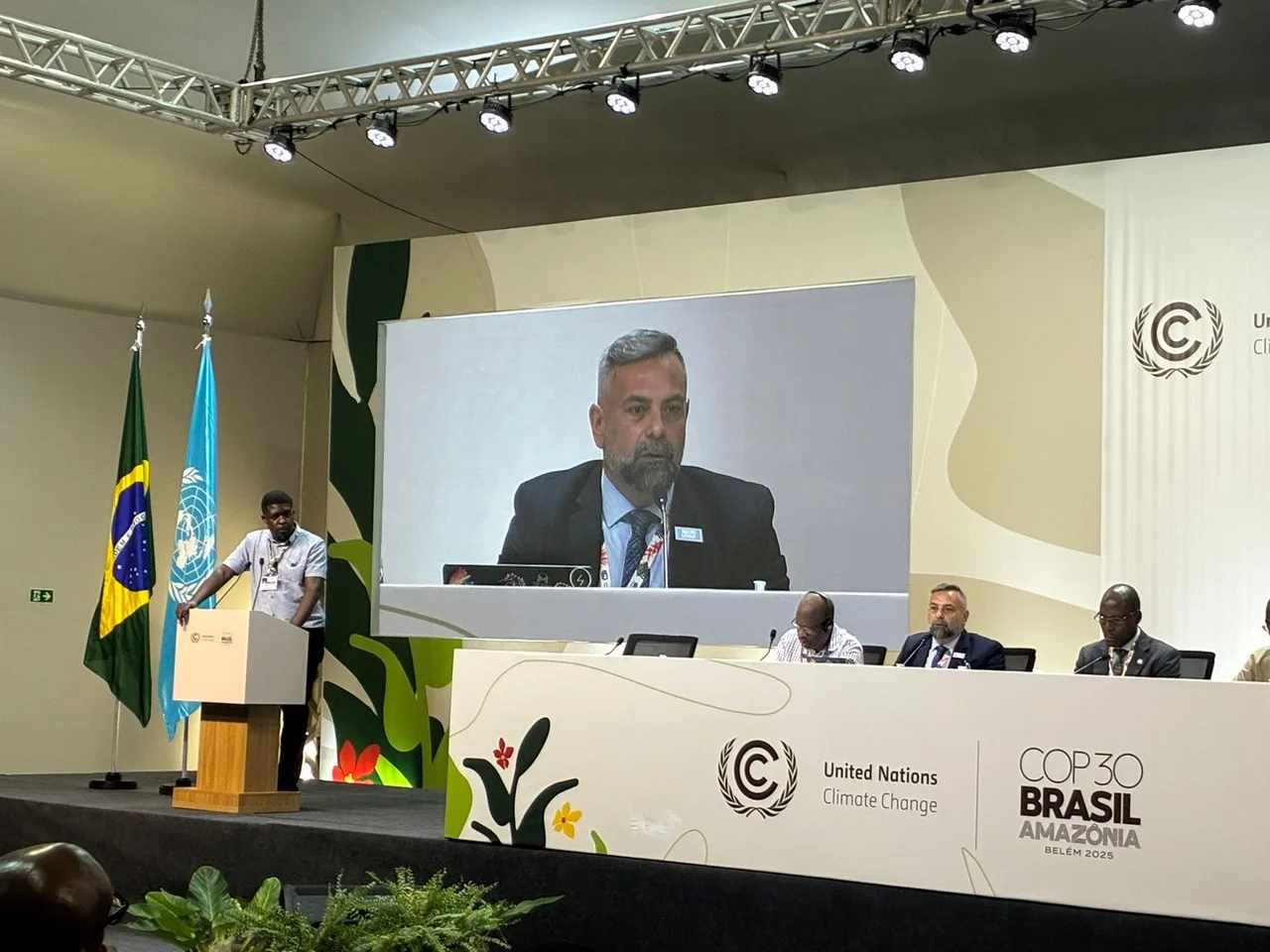
Malawi has introduced the world’s first artificial intelligence-enabled, blockchain-verified Paris Agreement Implementation Platform, marking a major moment for climate governance on Finance Day at COP30 in Belém, Brazil. The system, known as the Paris Agreement Implementation Platform (PAIP), establishes what officials describe as the world’s first “Environmental Treasury,” putting AI at the center of how countries measure, report, verify and auction climate actions.
Developed with the Green Economy Partnership (GEP) and TRST01, the platform integrates AI, satellite imagery, smart contracts, machine learning and blockchain infrastructure to verify climate projects with scientific accuracy. By securing all credits and transactions on a public ledger, Malawi aims to show that an African nation can not only meet its Paris Agreement commitments but also build a transparent, investor-ready marketplace for climate finance.
The PAIP connects every part of the national emissions value chain — from inventories and project origination to validation, auctioning and retirement — in a single digital ecosystem tailored to Malawi’s climate priorities. Through the Green Economy Partnership, the system will be offered at no cost to other Global South countries to speed up Article 6 implementation and expand access to advanced climate technologies.
Richard Perekamoyo, principal secretary in Malawi’s Ministry of Natural Resources and Climate Change, said the platform will enable the country to “track every ton of CO₂ for its efficacy, every hectare restored and the returns in terms of GDP, IRR and jobs of every dollar invested with scientific precision, strengthening trust in our national data and results.”
With AI embedded into a national emissions data lake and blockchain validating each activity, the system aims to give investors confidence that emission reductions and climate-project outcomes are independently verifiable. It will automate national greenhouse gas inventories, long-term strategies, project matching, resilience scoring and data confidence indexes, while providing auditable evidence for regulators and verifiers.
“Integrity begins with data,” said Ivano Iannelli, chief sustainability officer at GEP. He said the platform sets a new benchmark for transparency and accountability that could help raise investment across the Global South.
Minister of Natural Resources and Climate Change Jean Mathanga said the initiative signals a new era of African leadership in climate innovation. For Malawi, the system offers a pathway to attract green capital and create new economic opportunities. For other developing nations, it serves as a ready-to-use blueprint to turn climate commitments into investable assets without the high cost of traditional monitoring, reporting and verification systems.
Following its global debut, GEP plans to expand the platform across Africa, Asia and Latin America through its Digital Climate Transformation Program, aiming to accelerate Article 6 projects and channel climate finance more transparently to the countries most in need.
#Malawi #Launches #Worlds #AIEnabled #Paris #Agreement #Platform #Setting #Standard #Transparent #Climate #Finance #COP30