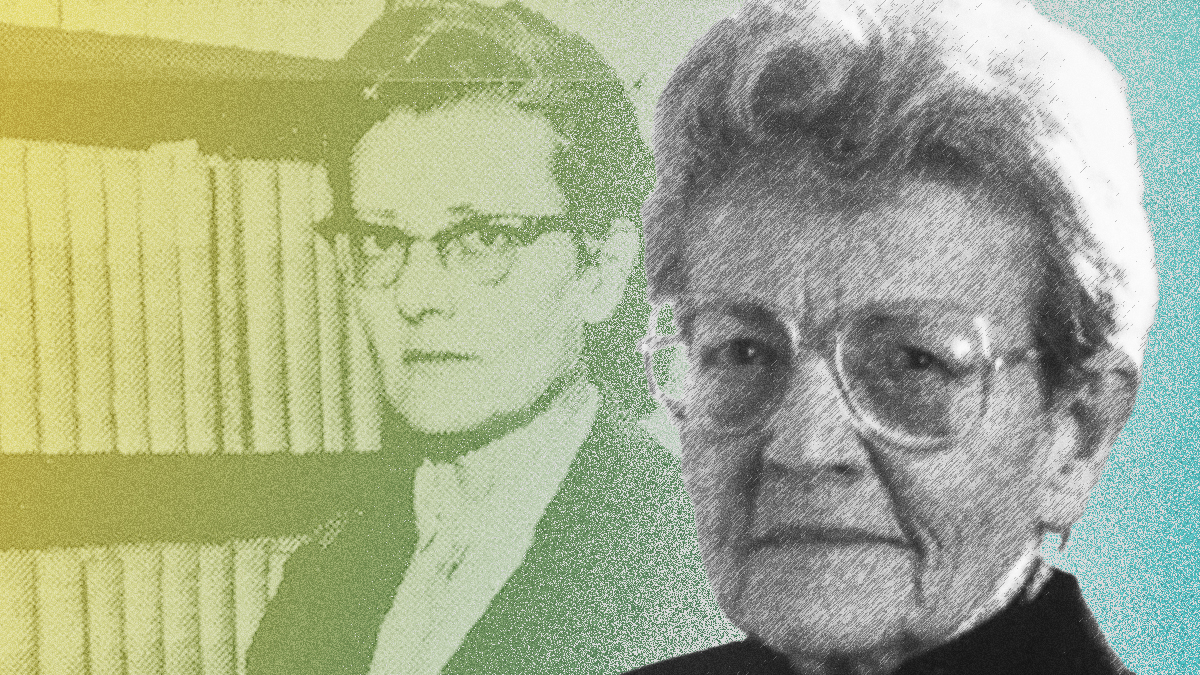
South Africa’s first woman judge and the first woman to be appointed a judge of the Supreme Court of Appeal, Leonora van den Heever, passed away on 22 November 2025 at the age of 99 in Cape Town.
In a statement, the Office of the Chief Justice described van den Heever’s career as a “testament to courage and perseverance”.
“Her legal mind was sharp, principled. She rendered judgments of clarity and conviction, moulding legal doctrine with integrity and a sense of justice that transcended the courtroom,” read the statement.
Minister of Justice and Constitutional Development, Mmamoloko Kubayi, wrote, “known for her sharp wit, humanity, and rigorous legal mind, she transformed the judiciary not only through her historic firsts but through the substance of her contributions.
“Her career opened doors for generations of women in law and remains a lasting example of judicial excellence,” she added.
Van den Heever was born on 9 July 1926 in the then South-West Africa, now Namibia, as the second child of Judge of Appeal and poet, Francois Petrus van den Heever, and Margaretha van den Heever.
At the time of her birth, her father had just been appointed legal adviser to the Prime Minister, General Hertzog. In 1933, the family moved back to Windhoek upon her father’s appointment as a judge there.
In 1938, her father became a judge in Bloemfontein, where Leonora matriculated in 1942 at the Oranje High School with various distinctions.
It has been recorded that before she matriculated, her father attempted to persuade her to take a legal degree.
However, she believed that “his shadow was already too long” and that she did not want to be known as just the daughter of an already-distinguished judge.
She obtained a BA degree cum laude at the University of Pretoria with English and Latin as majors, with plans of becoming a journalist. In 1947, she obtained an MA in English, again cum laude.
She returned to Bloemfontein without any definite plans for the future, just with “her suitcases, an enormous collection of books and a Dachshund puppy,” she once wrote.
In 1948, she taught for a term at Clocolan and later lectured at the Teachers’ College in Bloemfontein, experiences that convinced her she was not meant for a career in education.
Accidental entry into law

In July 1948, she returned to Bloemfontein just as her father’s registrar unexpectedly left. Recognising the significance, her father wisely asked her to assist him until a new registrar could be appointed.
This marked the start of her pioneering legal career.
Within two weeks, she was hired by Judge CP Brink of the Free State Bench, coinciding with her father’s appointment as an acting judge of appeal.
Judge Brink served in the circuit court, which introduced her to further legal aspects, solidifying her decision to pursue a career in law.
In 1951, she earned her LLB from the University of the Orange Free State, having studied extramurally while working for her father at the Appeal Court.
In 1952, van den Heever was admitted to the Orange Free State Bar as only the second woman, after Advocate Gladys Steyn, who soon left to enter politics.
For seven years, she practised law in Bloemfontein, gaining a reputation for her extensive legal knowledge and often appearing before the Appellate Division rather than handling simple divorce cases.
In 1958, she married Christo Neethling, who was soon transferred to Welkom.
By then, her commitment to the legal profession was strong; she decided to continue practising as an advocate from her home, as no chambers were available in Welkom, obtaining special permission from the Free State Bar Council.
Her dedication saw her through five more years of practice while raising three daughters. By 1964, the family moved back to Bloemfontein.
In 1968, Leonora made headlines as the first woman in South Africa to apply for silk, senior status formerly known as “Queen’s Counsel”.
The following year, she caused a greater stir by being appointed to the Free State Bench in an acting capacity for about six weeks.
Later in 1969, she became the first woman appointed as a judge in South Africa, serving in Kimberley.
At the end of 1979, she transferred to the Cape Division of the Supreme Court in Cape Town.
Over the next decade, she frequently acted on appeals at the Bophuthatswana Court and served as a commissioner and member of the Inquiry into alleged irregularities in the Department of Education and Training.
In 1991, she was appointed as a judge of appeal in the Bloemfontein Appeal Court, the first woman to be appointed there, serving until her retirement in July 1996.
Until 1994, Judge van den Heever was the only woman judge in South Africa.
She served on the Appeal Bench of Lesotho from 1996. She also acted as a judge for several months in the Cape Provincial Division of the Supreme Court.
Not just on the bench

Besides her judicial career, she was a cultured woman and an esteemed author, writing children’s books, short stories, and contributing significantly to South African literary life.
Van den Heever chaired the South African Library Board, served as a trustee for the Cape Town Ballet Benevolent Fund, and was a member of the William Humphreys Art Gallery Board during her Kimberley years.
In 1987, she was named Western Cape Woman of the Year by the Women’s Bureau.
In 1996, she received a Chancellor’s Medal from the University of Pretoria, as well as honorary doctorates in Law by the University of Stellenbosch and the University of Nelson Mandela.
#story #woman #judge #South #Africa #Newsday