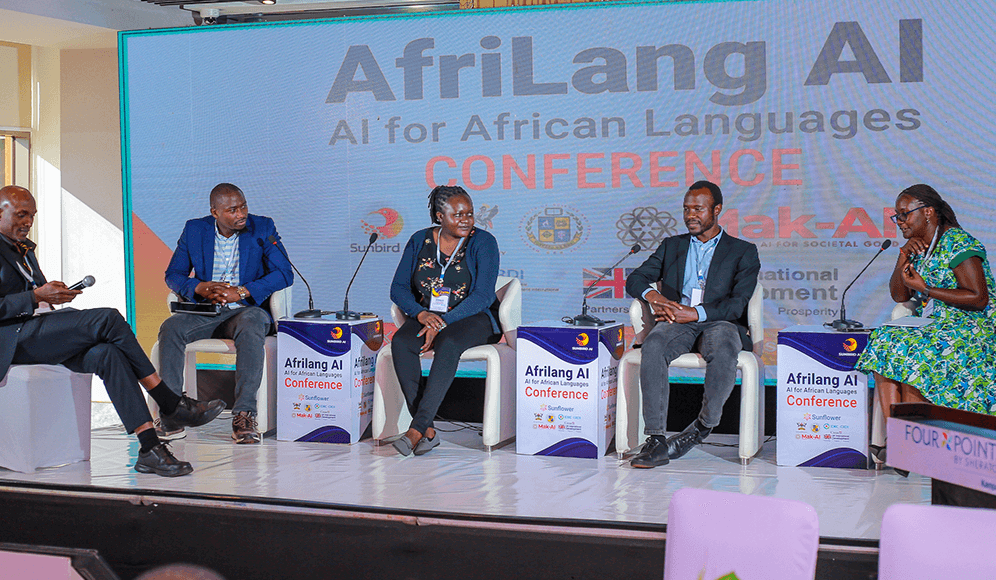
The 2025 AI for African Languages Conference brought together researchers, practitioners, and innovators in natural language processing to address one of Africa’s most persistent technological challenges: the underrepresentation of African languages in modern artificial intelligence systems.
Held at the Four Points by Sheraton, the conference served as a collaborative space for experts across the continent to share research, explore new technologies, and advance inclusive language innovation. The program focused heavily on East Africa’s diverse linguistic landscape and the work required to bridge the “low-resource” gap that limits access to AI tools for many African languages.
A Milestone Launch for Uganda
A major highlight was the official launch of Sunflower, Uganda’s first multilingual large language model, developed by Sunbird AI. The model was unveiled by Dr. Aminah Zawedde, permanent secretary of the Ministry of ICT and National Guidance, and John Quinn, research director at Sunbird AI.
Sunflower can understand and communicate in more than 30 Ugandan languages, enabling translation, summarization, and question answering in local contexts. It was trained using books, radio archives, and community data to reflect authentic Ugandan speech patterns. The model outperforms global AI systems in 24 of 31 tested languages.
Dr. Zawedde described the launch as “not just a technological achievement but a cultural one,” saying it demonstrates the need to ensure that African languages are not excluded from modern digital platforms. She urged students and innovators to develop tools that eliminate language barriers and make technology more inclusive for Ugandans.
Language Technology for Social Impact
During a panel discussion, Dr. Joyce Nabende, director of the Makerere Centre for Artificial Intelligence, highlighted the societal importance of language technologies. She said natural language tools could support citizens in real-world situations, such as improving access to justice for those who cannot communicate in English within legal systems.
“If everything is perfect—text, ASR and models—how would these tools be useful to society? Imagine a widow in court who doesn’t speak English; this technology could give her a voice,” Nabende said.
Research and Collaboration Priorities
The conference invited submissions and discussions across a wide set of natural language processing themes, including:
- Data collection and annotation for low-resource African languages
- Machine translation and cross-lingual learning
- African speech technologies
- Ethical considerations and bias in AI systems
- NLP applications for social good in education, healthcare, agriculture, and cultural preservation
- Large language models for multilingual understanding
Toward a More Inclusive Digital Future
Uganda has more than 40 living languages and a linguistic diversity score of 0.928. That diversity represents both cultural strength and technological complexity. Conference discussions and the Sunflower launch show how African-led innovation can help modern AI systems become more representative and accessible.
The AI for African Languages Conference reaffirmed a shared vision: building a digital future where technology understands every African voice.
The initiative is a partnership between the Makerere University Centre for Artificial Intelligence, Mbarara University of Science and Technology, and is supported by the International Development Research Centre and the UK’s Foreign, Commonwealth and Development Office.
#Conference #Unveils #Ugandas #Multilingual #Language #Model #Support #African #Languages