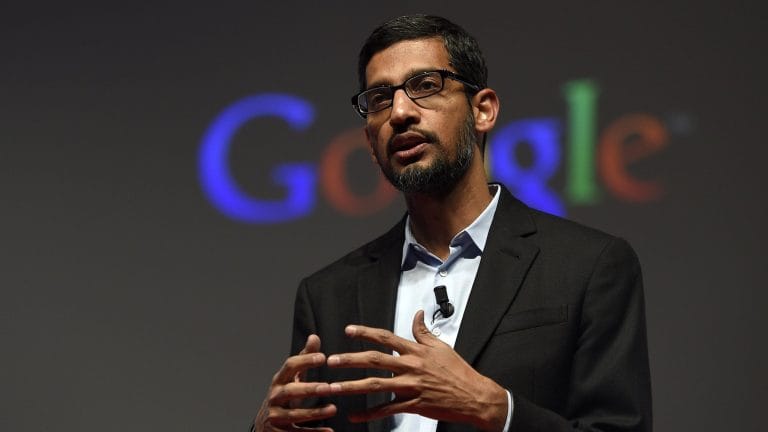
Alphabet CEO Sundar Pichai says no company, including Google, would be immune if the artificial intelligence market were to suffer a valuation correction.
In an exclusive interview with BBC News at Google’s California headquarters, Pichai said the rapid surge in AI investment is “an extraordinary moment,” but he acknowledged “irrationality” in parts of the market.
Asked whether Alphabet would be protected if an AI bubble burst, Pichai said, “I think no company is going to be immune, including us.” He added that while Google could weather volatility, the industry faces a period of heavy speculation.
His comments come as valuations for major AI companies have risen sharply and capital spending on the technology sector reaches historic highs. Alphabet’s market value has doubled in seven months to $3.5 trillion as investors gain confidence in its AI strategy and its ability to compete with OpenAI.
Alphabet is building specialized AI chips that compete with Nvidia, which recently became the world’s first $5 trillion company. Analysts have expressed concern about a complex network of $1.4 trillion in deals surrounding OpenAI, whose expected revenue this year is far below the scale of recent investment.
Those concerns have sparked comparisons to the dotcom bubble of the late 1990s, when early internet firms surged in value before collapsing in 2000. The downturn caused company failures, job losses and declines in retirement savings.
Pichai said technology cycles often “overshoot” before stabilizing.
“We can look back at the internet right now. There was clearly a lot of excess investment, but none of us would question whether the internet was profound,” he said. “I expect AI to be the same. So I think it’s both rational and there are elements of irrationality through a moment like this.”
JP Morgan CEO Jamie Dimon earlier told the BBC that while AI investment will deliver returns, some capital is “probably going to be lost.”
Pichai said Alphabet has advantages because its operations span “the full stack,” including hardware, large-scale data, foundational models, and scientific research. He said this positioning could help Google withstand market turbulence.
Alphabet is also expanding in the United Kingdom. In September, the company announced a £5 billion investment in AI infrastructure and research over two years. Pichai said Alphabet plans to conduct advanced model training in the UK, a move supported by British officials who want the country to become the world’s third major AI hub after the United States and China.
“We are committed to investing in the UK in a pretty significant way,” he said.
However, he warned that AI’s energy demands are substantial. AI accounted for an estimated 1.5 percent of global electricity consumption last year, according to the International Energy Agency.
Pichai said economies must scale energy supply and infrastructure or face growth constraints. Alphabet is still targeting net-zero emissions by 2030, although he admitted progress may slow as AI workloads expand.
“The rate at which we were hoping to make progress will be impacted,” he said.
Pichai said AI will also reshape employment, calling it “the most profound technology” humanity has worked on. While he expects job transitions and disruptions, he said workers who learn to use AI tools will benefit.
“It doesn’t matter whether you want to be a teacher or a doctor. All those professions will be around, but the people who will do well in each of those professions are people who learn how to use these tools,” he said.
#Alphabet #CEO #Warns #Bubble #Hit #Company