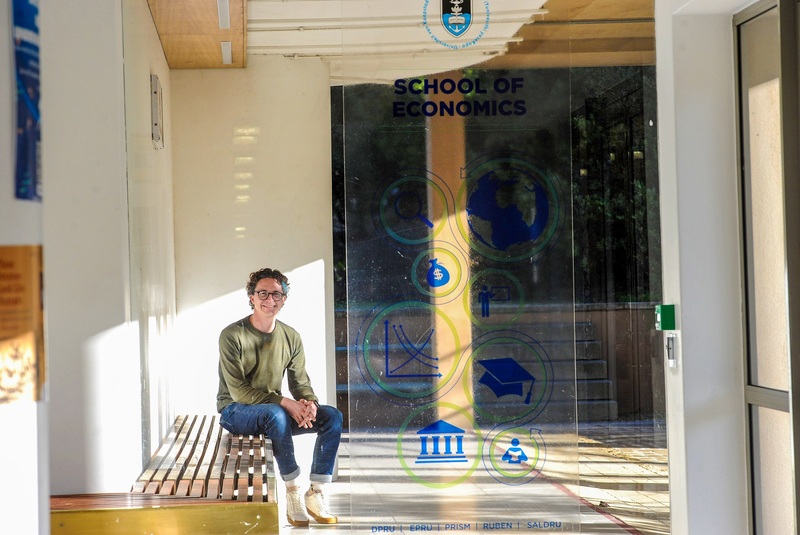
A researcher at the University of Cape Town has received an international research grant to examine whether artificial intelligence can improve employment prospects for unemployed young people in South Africa.
Dr. Tim Köhler, a senior research officer at the Development Policy Research Unit in UCT’s School of Economics, is one of 19 early-career researchers selected from more than 300 applicants worldwide to receive funding under the AI at Work program run by Schmidt Sciences. The initiative is investing more than $3 million in research on how generative AI is reshaping labor markets.
Köhler’s study is the only South African-led project in the global cohort and will generate the first rigorous evidence on how a generative AI-powered career guidance tool affects job-search outcomes for unemployed youth in a developing-country context.
Youth unemployment remains one of South Africa’s most pressing socioeconomic challenges. According to Statistics South Africa, about 60% of the labor force aged 15 to 24 and 40% of those aged 25 to 34 are unemployed, affecting roughly five million young people.
Köhler said information constraints play a significant role in keeping young jobseekers out of work. Many do not know which career paths are viable, what skills employers demand or how to navigate both formal and informal labor markets.
“If AI can help young people navigate these complexities here, the lessons are likely to be relevant for many other countries across the continent and the Global South,” he said.
The AI at Work program supports studies examining AI’s impact on worker productivity, wages and employment. Nobel laureate economist Daron Acemoglu, one of the program’s reviewers, said in a statement that while AI is poised to transform many aspects of life, its impact on labor markets remains uncertain.
Köhler’s project will evaluate an AI-based career guidance tool co-designed with a Cape Town technology firm and developed for low-bandwidth environments. Powered by large language models, the tool will provide personalized advice through a conversational interface accessible via phone or computer.
Users will receive tailored guidance on identifying job opportunities, improving CVs, preparing for interviews and exploring training or self-employment options.
The study will use a randomized controlled trial, widely regarded as the gold standard for measuring impact, to determine whether access to the AI tool improves employment outcomes, job-search behavior, confidence and expectations.
“There’s a lot of excitement about AI, but still relatively little rigorous evidence, especially in developing countries,” Köhler said. “This approach allows us to test what actually works.”
The research will also assess potential unintended consequences, such as reinforcing inequality or raising expectations without improving access to opportunities.
Köhler cautioned that AI is not a “silver bullet” for unemployment but could help ease specific constraints young people face. If effective, the tool could offer a scalable, low-cost complement to public employment programs and job-readiness initiatives.
“Youth unemployment is one of the country’s most pressing development challenges,” Köhler said. “Identifying interventions that can meaningfully alleviate it is essential for inclusive policy.”
He said the broader aim is to contribute to responsible, evidence-based approaches to using technology to expand opportunity and reduce poverty and inequality.
#UCT #Researcher #Wins #Global #Grant #Study #AIs #Impact #Youth #Employment #South #Africa