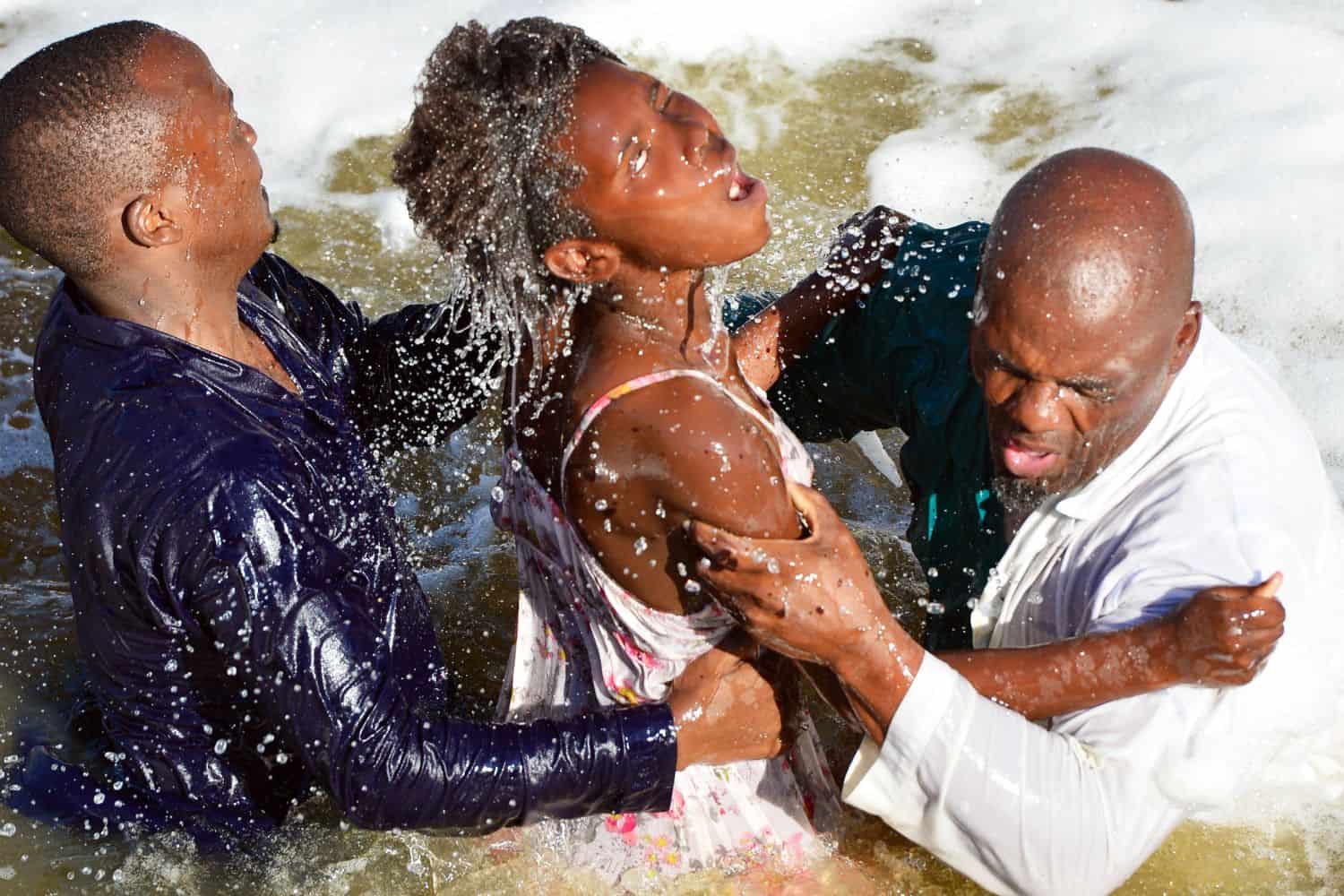
Worshippers believe the water allows sins to flow away.
Every Sunday, scores of people from various spiritual traditions assemble along the Klip River, which runs through Soweto and Lenasia, to participate in spiritual rituals, including baptisms.
“The water cleanses us. It is holy,” says Lee Ndlovu, a Lenasia resident who comes to the river nearly every week.
“You have people from everywhere using the river. Churches, sangomas, all of them use it.”
ALSO READ: What’s really in your water? Damning report highlights how South Africa is failing
Worshippers believe the water allows sins to flow away. But as people were being baptised behind him, one could see the water foaming in places.
Ndlovu said people “have gotten sick” from the water, but “it is worth it … because the water is sacred.”
Ndlovu says many people come to the river out of desperation, with the hope that this spiritual act will provide them with a job.
“This river answers prayers,” he said.
Polluted waters
Department of Water and Sanitation spokesperson Wisane Mavasa said the section of the Klip River that runs through Gauteng has unsafe levels of E.coli, which is a direct indicator of faecal contamination, and of the pesticide endosulfan, which, due to its toxicity, has been restricted or banned in over 60 countries.
Untreated sewage flows from the City of Johannesburg’s Goudkoppies wastewater treatment works into the river.
Downstream of the treatment works, where communities live along the river banks, the water gives off a repugnant odour.
The river foams from the pollution, and the water is murky.
Mavasa said a criminal case will “soon be submitted” to the NPA regarding non-compliance at Goudkoppies.
In addition to the failing sewage works, the river is polluted by toxic industrial and mining runoff, and household waste from surrounding communities.
A 2025 environmental assessment in Soweto by researchers from the University of Johannesburg found an “alarming presence of organic chemicals linked to organ damage, developmental disorders, and cancer in the river’s sediments.”
READ MORE: SA’s water crisis deepens as audit reveals municipalities are losing more water than they use
Dr Mathapelo Seopela, one of the study authors, explained that sediments contaminated with polycyclic aromatic hydrocarbons (PAHs) pose a threat to communities that use river water.
PAHs primarily come from oil spills, industrial runoff and leaking fuel tanks, as well as the burning of coal, waste and biomass.
Livestock graze along the banks, “risking toxin transfer to meat and dairy”, said Seopela. Biodiversity, fish reproduction and the survival of amphibians are also at risk.
“Urbanisation, inadequate waste management and historical pollution have turned the Klip River into a chemical reservoir,” said Seopela.
The damaged wetlands are not able to filter out the contaminants.
The researchers studied the effect of the toxins on zebrafish embryos. The toxins were found to cause heart problems and spinal deformities.
Zebrafish are the gold standard for toxicity testing because of their biological similarity to humans.
The river is an important water source for residents and a key tributary to the Vaal River system. The section of the river that runs through the Free State is not as heavily polluted.
No accountability
It is three years since civil society organisation WaterCAN laid criminal charges with the police and Green Scorpions against the City of Johannesburg and its municipal manager for persistent environmental negligence.
WaterCAN alleges the municipality has violated the National Water Act, which makes it a criminal offence to fail to comply with directives from the Department of Water and Sanitation.
The department had in 2022 issued a directive to end raw sewage flows into the Klip River.
WaterCAN executive director Ferrial Adam said officials have faced no accountability.
“This delay and lack of transparency should alarm all of us.
“It raises serious questions about whether environmental crimes are being treated with the seriousness they deserve,” said Adam.
READ MORE: Are corrupt water officials getting away with it?
“Instead, the process appears to have stalled behind closed doors, with no answers and no accountability.”
She said this sends a dangerous message that environmental laws can be ignored without consequence and that the health and dignity of affected communities are undervalued.
It is unclear whether the case has been handed to the National Prosecuting Authority (NPA), she said.
“Accountability cannot be optional, and it cannot take years while people continue to suffer the consequences.
“The Klip River is dying under the weight of this pollution,” said Adam.
This article was republished from GroundUp under a Creative Commons licence. Read the original article here.
#baptisms #Joburgs #polluted #water