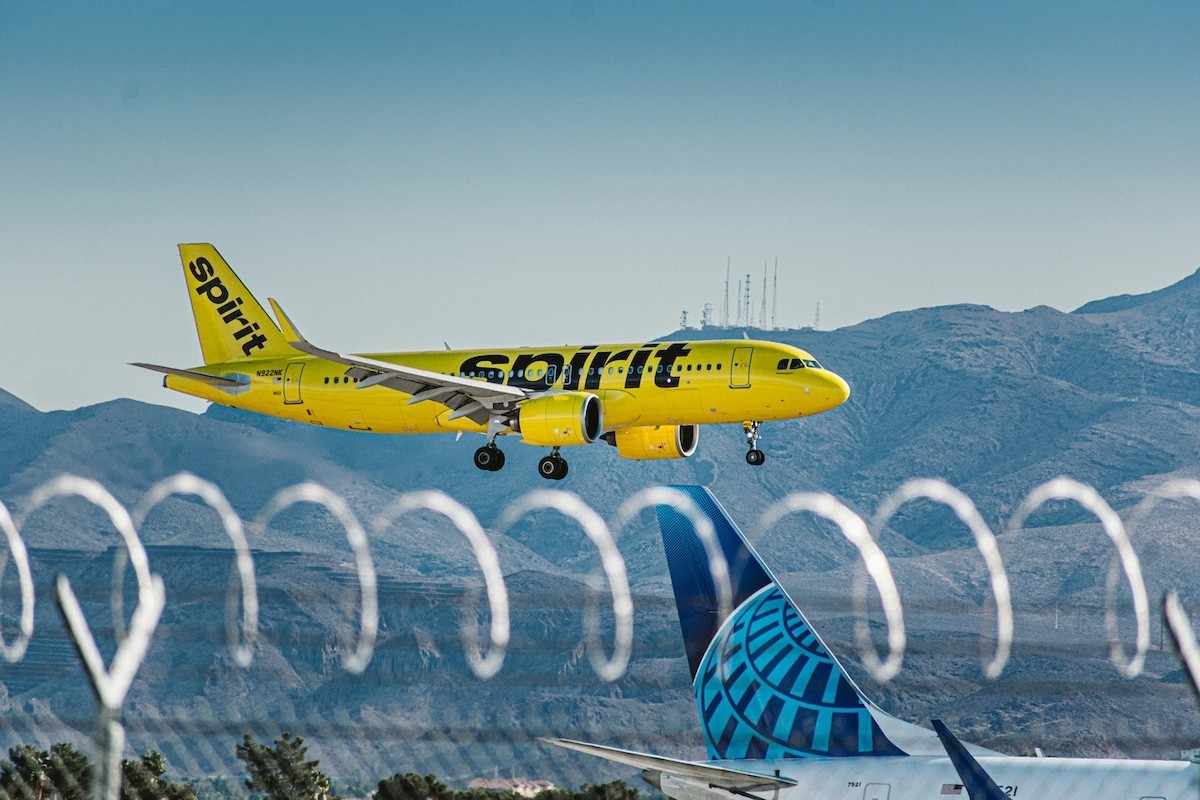
It was a weird comment. On Thursday, 23 April 2026, Donald Trump talked about Spirit Airlines like a distressed asset he was personally going to flip. Good aircraft. Good gates. Wait for oil to drop, sell at a profit. The Art of the Deal, applied to a yellow-liveried budget carrier on its second bankruptcy in two years.
But, it turns out, there’s more folks! Turns out Spirit was not THE deal. Spirit was the trial run. The Association of Value Airlines, which represents Frontier, Avelo, Allegiant, Sun Country and Spirit, has collectively asked the Trump administration for $2.5 billion (around R41.4 billion at the mid-market rate of R16.55 to the dollar). The structure mirrors the Spirit pitch. Federal cash now, warrants for equity later. Pay us today. Trust us to make you whole tomorrow.
The chief executives flew to Washington last Tuesday and met with Transportation Secretary Sean Duffy and Federal Aviation Administration head Bryan Bedford. Talks are ongoing. The number was not plucked from the air. It is what the airlines reckon they will overspend on jet fuel this year if prices stay above $4 a gallon, which they are, because Iran and the Strait of Hormuz are not done with global oil markets yet.
The pitch and the precedent
It’s all about what the airlines are not saying out loud. They have run this little gig before. So has the United States Treasury. And the result was not encouraging.
During the COVID-19 pandemic, Washington ploughed $54 billion (around R893.7 billion) into the airline industry through the Payroll Support Programme. In exchange, Treasury collected stock warrants from eleven publicly traded carriers. Four years later, in June 2024, those warrants were auctioned. The total recovered for taxpayers came to $556.7 million (about R9.2 billion). Reuters reported many of the warrants proved to be of little value.
Roughly one cent on the dollar. The warrants were the part of the deal designed to protect taxpayers from the bailout becoming a giveaway. They mostly did not.
Now the same instrument is being offered again, by airlines who already know what those warrants are worth.
The South African mirror
A South African reading this will recognise the architecture. The vocabulary differs. The choreography is identical. Pump capital into a struggling airline. Take paper securities in return. Promise the public a profitable exit. Watch the exit recede.
Since 2000, South African taxpayers have poured around R145.3 billion into state airlines, with SAA accounting for R133.3 billion of the total on its own. The carrier has not turned an honest operating profit since 2011.
The R155 million it reported for the 2024-25 financial year was sustained by a Heathrow slot sale and a R1 billion government share injection Transport Minister Barbara Creecy refused to label a bailout. The CEO and CFO have since resigned. Treasury is reportedly preparing another funding round for May.
The American argument has always been institutions, an independent press and bankruptcy courts immune from political capture would prevent the South African outcome. The argument was always a bit thin. It is thinner now. When five airlines walk into the Cabinet Room and ask for $2.5 billion in fuel-cost rebates dressed as equity warrants, the institutions are not constraining the politics. They are servicing it.
What changed in ten days
The earlier Spirit story read plausibly as a national security oddity. Defense Production Act. Pentagon transport. One distressed carrier, one set of warrants, one line item buried in a strategic narrative.
The Frontier and Avelo move strips the Spirit pitch of the costume. There is no national security story for Avelo, which runs leisure routes from Tweed-New Haven and Burbank. There is no military logistics case for Sun Country, which mostly flies sun-seekers to Mexico. The pitch is what it always was. Higher fuel prices have ruined the budget-airline business model. Washington should write a cheque.
And, of course, the Iran war is the trigger. Jet fuel prices have roughly doubled since the strikes on Tehran’s facilities. Budget carriers, whose entire model is squeezing the last cent out of every seat-kilometre, do not have the pricing power Delta and American carry. They have no way to pass the increase through. They have come to Washington instead.
The thing about temporary
There is a sentence Pretoria’s Treasury officials recognise. It is the one going, “This is a temporary intervention”. SAA was a temporary state airline. Eskom was a temporary debt-relief recipient. The Post Office was a temporary modernisation project. The temporary became the permanent the moment political constituencies attached to it.
The Trump administration is at the start of that loaded sentence. Five airlines, $2.5 billion, warrants of dubious worth, jet fuel above $4 a gallon and no plausible exit. The fundamentals which produced the South African pattern are now in play. The only difference is the currency in which the bill is being printed.
Pretoria’s experiment has been running for 25 years. Washington’s started recently. Good luck with that.
#Americas #budget #airline #bailout #Spirit #start #story