Zimbabweans In Renewed Xenophobia Fears in South Africa
By A Correspondent-Zimbabwean nationals in South Africa are facing renewed fears for their safety following a fresh wave of anti-immigration protests, raising concerns about a possible resurgence of xenophobic violence .
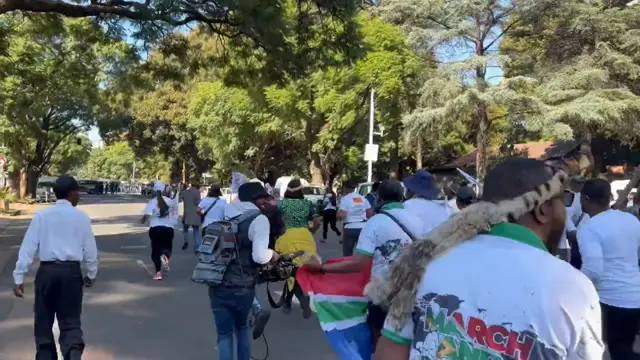
The latest demonstrations, led by civic group March and March, culminated in a march to the Union Buildings in Pretoria on Tuesday, where protesters accused the government of failing to address undocumented migration. While organisers called for peaceful action, previous protests linked to the group have reportedly been associated with sporadic violence in parts of KwaZulu-Natal, the Eastern Cape, and Durban.
A visible police presence, including the South African Police Service and Tshwane Metro Police, was deployed to monitor the march and prevent escalation. However, the protests come against a broader backdrop of rising tensions over migration, unemployment, and service delivery, issues that have historically fuelled xenophobic sentiment in South Africa.
South Africa has experienced several waves of xenophobic violence since 2008, often targeting African migrants, including Zimbabweans, Mozambicans, and Nigerians. These attacks have typically been linked to economic hardship, competition for jobs, and pressure on public services, although analysts note that they are also shaped by deeper social and political dynamics.
Zimbabweans, who form one of the largest migrant communities in South Africa, are particularly affected. Many entered the country under the Zimbabwe Exemption Permit (ZEP), a special dispensation introduced in 2009 to regularise the stay of Zimbabweans fleeing economic and political instability. The ZEP has allowed holders to live, work, and study in South Africa legally. However, uncertainty around its renewal and ongoing policy shifts has left many Zimbabweans vulnerable, with fears of losing legal status and protection.
At the same time, administrative challenges continue to complicate migrants’ ability to secure employment. The South African Qualifications Authority (SAQA) has acknowledged delays in verifying foreign qualifications, particularly those from Zimbabwe, citing difficulties in confirming credentials with institutions that may no longer exist.
Speaking at the Zimbabwe International Trade Fair, SAQA’s Senior Specialist for Communications and Advocacy, Nkosingiphile Nyalungu, said the authority is working to improve cooperation with Zimbabwean institutions to address these delays. “The process takes longer because we rely on third parties to assist us with proper verifications,” she said.
These bureaucratic hurdles add to the broader pressures faced by migrants, many of whom are already navigating precarious legal and economic conditions. Analysts argue that such structural challenges can heighten tensions, particularly in communities already experiencing high unemployment and inequality.
President Cyril Ramaphosa, speaking during Freedom Day commemorations in Bloemfontein, acknowledged the growing concerns around migration but warned against allowing these concerns to fuel xenophobia.
“It cannot be and must never be that we trample into the dust of the African fellowship that made our freedom possible,” Ramaphosa said. “We should never allow the legitimate concerns of our communities about illegal migration to breed prejudice towards our fellow Africans.”
Police leadership has also condemned acts of violence linked to anti-immigration protests, stressing the need to uphold the rule of law and protect all residents regardless of nationality.
Observers note that South Africa’s migration debate remains deeply complex, sitting at the intersection of economic strain, governance challenges, and regional inequality. While public frustration over unemployment and service delivery is real, experts caution that targeting foreign nationals risks deepening social divisions rather than addressing underlying structural issues.
As tensions continue to simmer, Zimbabweans and other migrants remain caught between policy uncertainty, administrative barriers, and the persistent threat of xenophobic hostility — a reminder that the promise of African unity remains contested on the ground.
Related
#Zimbabweans #Renewed #Xenophobia #Fears #South #Africa #ZimEye